

How Nigeria did IMF Reforms Without the IMF
Babangida rejected the loan, ran the program anyway, and got Nigeria's debt rescheduled. A World Bank official called it "a political masterpiece."

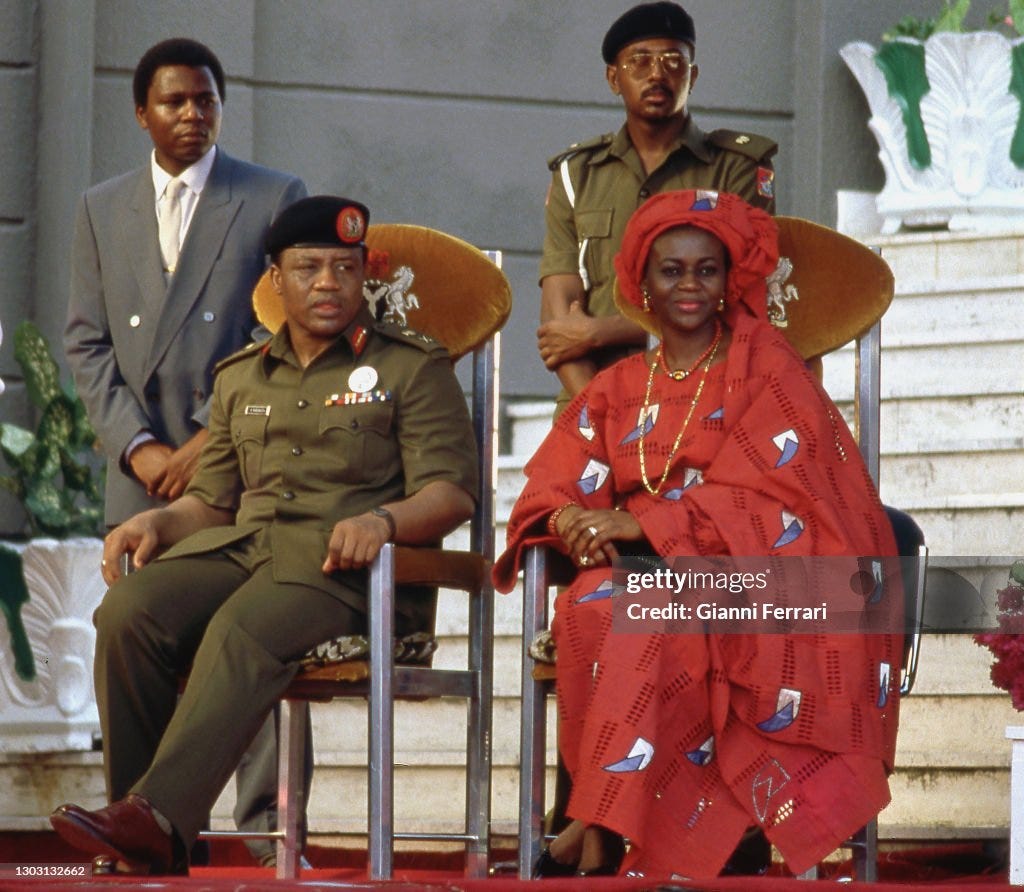
In late August 1985, military officers overthrew Muhammadu Buhari in Nigeria’s 6th post-independence coup. Major General Ibrahim Babangida, a veteran of the three previous coups, took over.
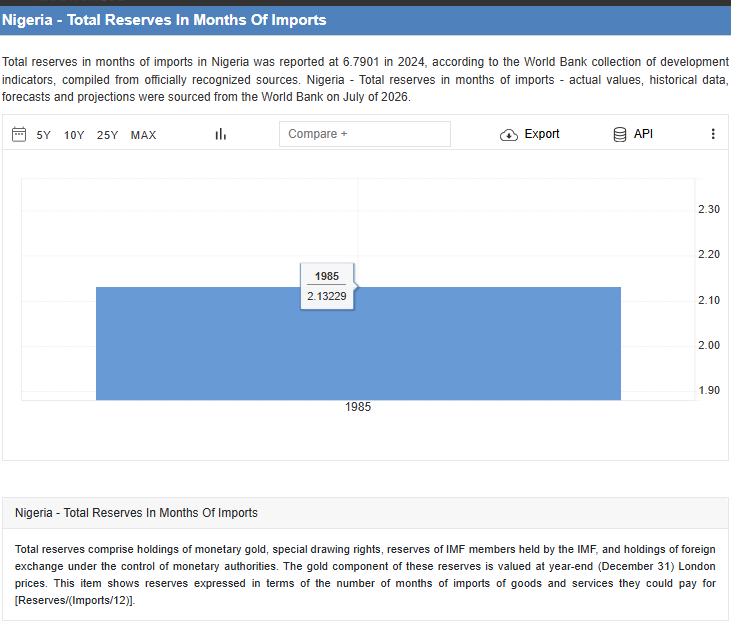
When Babangida took power, his finance ministry warned him that Nigeria was “on the verge of external bankruptcy”. Global oil prices were still falling, foreign debt payments consumed ~33% of Nigeria’s export earnings, and foreign exchange (FX) reserves dwindled to just 2 months of import coverage. In concrete terms, hospitals struggled to import basic medicine, and factories could not import the raw components they needed to stay open.
Unlike Buhari, Babangida did not initially promise quick prosperity. He candidly told Nigerians that the country was broke and would need three years of sacrifice before a turnaround.
He immediately declared a 15-month economic emergency, banned rice & corn imports to preserve Nigeria’s scarce (FX) reserves, and dismantled Buhari’s corrupt oil-for-goods barter trading, which relied on secret contracts, weak inspections, inflated invoices, discounted oil, and military-connected middlemen.
Recap: When Nigerians tried homegrown solutions instead of the IMF
Crude oil is the lifeblood of Nigeria’s economy, driving ~95% of Nigeria’s FX earnings and 80% of Nigeria’s government revenue. ~80% of the oil was bought by the Western buyers.
Between the end of the civil war to 1981, Nigeria earned ~$100B from selling oil. During the boom, Nigeria’s annual federal revenues exceeded $20B, and the World Bank reclassified Nigeria from a low income country to a middle income nation.
When Western economies slid into recessions in the early 1980s, global oil prices crashed. The revenues that Nigeria used to subsidize emerging industries, employ government workers, defend the naira, & build infrastructure quickly evaporated.
In previous articles, I covered how civilian president Shehu Shagari (1979-1983) and military leader, Muhammadu Buhari(1983-1985) each tried to hack their way out of the global oil price crash without an IMF loan & reform program. Both their strategies failed catastrophically:
Shagari’s Print, Borrow, & Burn strategy: Shagari trimmed the national budget, but oil government revenue shrank faster than Shagari could cut. Nigeria’s central bank printed naira to directly finance Nigeria’s deficits, adding inflationary pressure. To suppress inflation & defend an artificially strong naira, Shagari burned through Nigeria’s $10B in FX reserves and leaned on letters of credit from foreign banks to flood Nigeria with relatively cheap foreign goods. By 1982-1983, the war chest emptied, inflation spiked, Nigeria missed payments on foreign loans, and then international banks stopped lending to Nigeria.
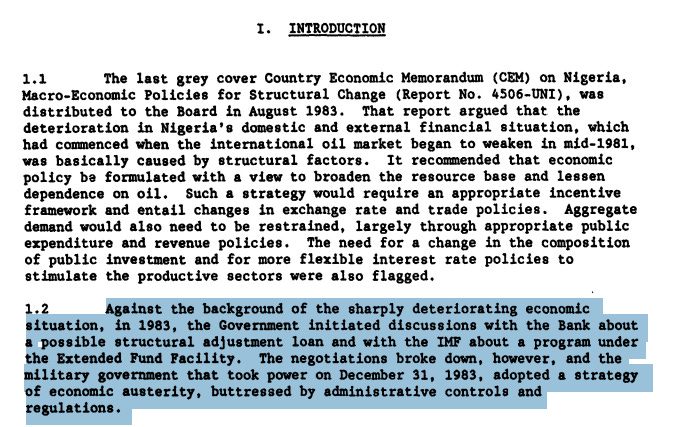
Buhari’s Brute Force gamble: After overthrowing Shagari, Buhari inherited almost no FX reserves and little access to foreign credit. Buhari tightened import restrictions, cut budgets, and bartered Nigerian oil directly for goods. Starved of foreign parts & raw materials due to a lack of FX, industrial joint-ventures like Steyr-Nigeria or Volkswagen-Nigeria missed production targets, became unprofitable and laid off staff.
By the time Babangida seized power, the compounding failures of both governments left Nigeria trapped between a sovereign debt crisis and crashing global oil market.
The Lethal Combo Babangida Inherited
Nigeria was in a classic balance-of-payments crisis. The nation relied on imports for 70% of its food & raw materials, but lacked the FX to pay for them since oil prices were falling. On top of this, Nigeria had over $22B in foreign debt.
Debt Crisis: Stock vs. Flow
But $22B is just the “stock”, the immediate danger came from the annual “flow” of debt payments. Nigeria had 2 months of foreign reserves to cover imports (under 3 is crisis level) and Nigeria’s debt service devoured one-third of foreign currency earnings (over 25% is crisis levels).
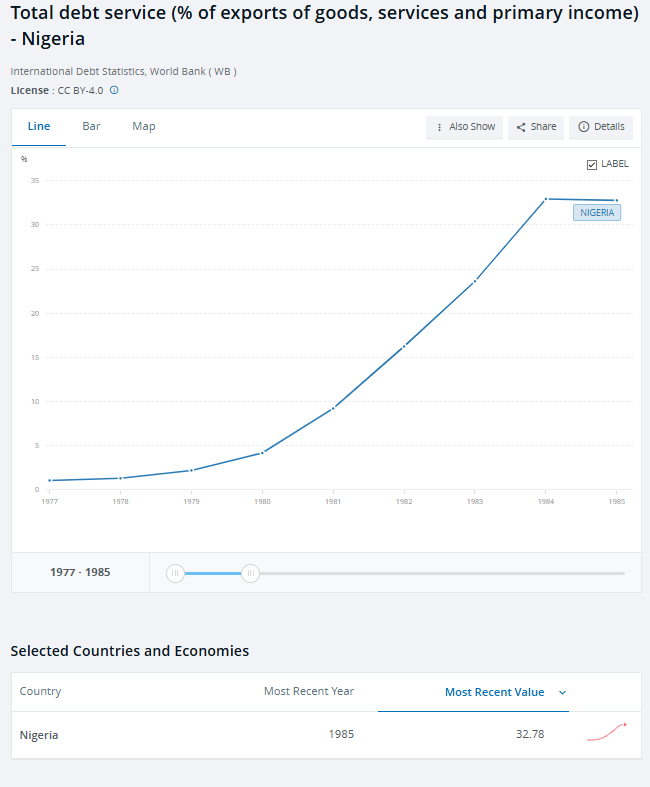
If a country borrows in a foreign currency, it must repay the loan in that currency. Nigeria can’t print dollars, just naira. It could print naira and buy back dollars, but flooding the market with local currency devalues the naira’s exchange rate to the dollar.
If Nigeria wanted to pay off foreign debt without devaluing its currency, it must earn more foreign currency, whether its export services (e.g. tourism), primary income (e.g. remittances), or exporting goods.
Since debt service was eating so much of Nigeria’s declining export earnings, Nigeria fell behind on paying trade letters of credit. Western banks claimed that Nigeria was already 120 days behind repaying short-term debts and responded by freezing new letters of credit for Nigerian importers.
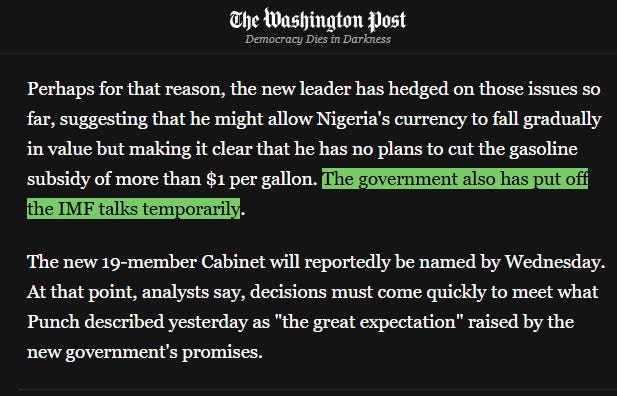
Shagari and Buhari had both rejected IMF reforms during an oil-price collapse and both failed. Babangida decided to experiment with an IMF-style reform.
Our Nigeria Series so far:
Overview of Nigeria: I
Pre-Colonial Northern & Southern Nigeria: II, III, IV, V, & VI
British Conquest, Rule, & Independence: VII, VIII, IX, X, & XI
Military Rule: Gowon (XIV), Murtala-Obasanjo (XV)
Return to Military Rule: Buhari (XVIII)
From Bad to Worse: Nigeria’s Second Oil Shock
Not only did Babangida inherit a mess, but global oil prices were about to collapse further.
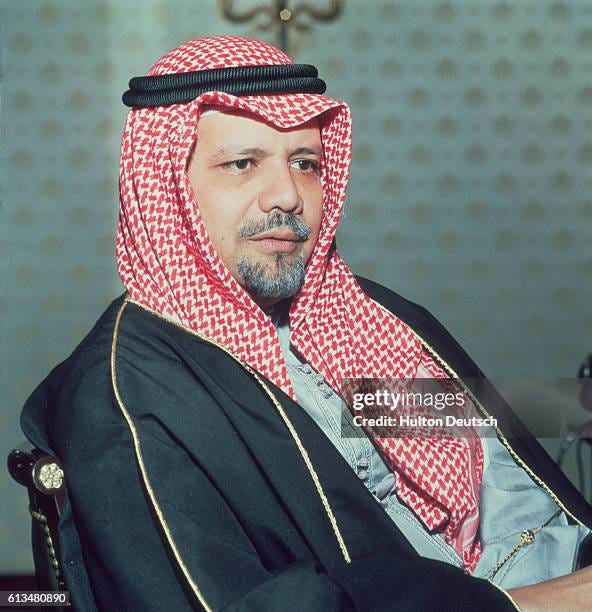
After years of reducing output to prop up oil prices after the mid 1981 price collapse, Saudi Arabia’s Oil Minister, Sheik Ahmed Zaki Yamani, declared that Saudi Arabia would expand oil production, flooding an already oversupplied market.
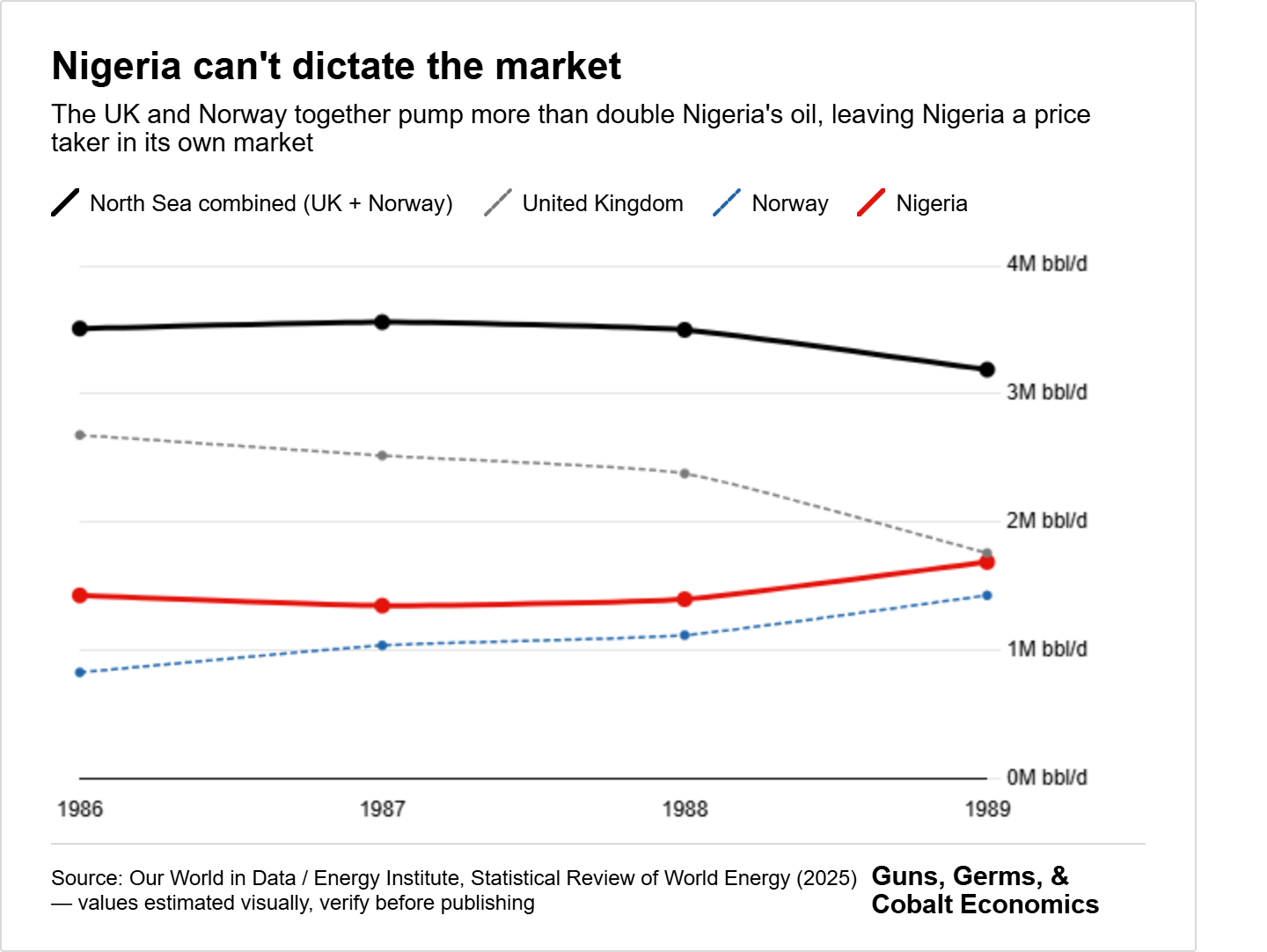
At the same time, non-OPEC producers in the North Sea (UK & Norway) had more than double the production of the exact premium low-sulfur crude that Nigeria exported, stripping Nigeria of its ability to dictate prices for its own crude. Not only did the UK already outproduce Nigerian oil production in the late 1980s, but Norway was ramping up production and was nearly matching Nigeria’s output.
The increased oil supply, especially from Saudi Arabia pushed the price of a barrel of oil down from $28 toward $18 and lower.
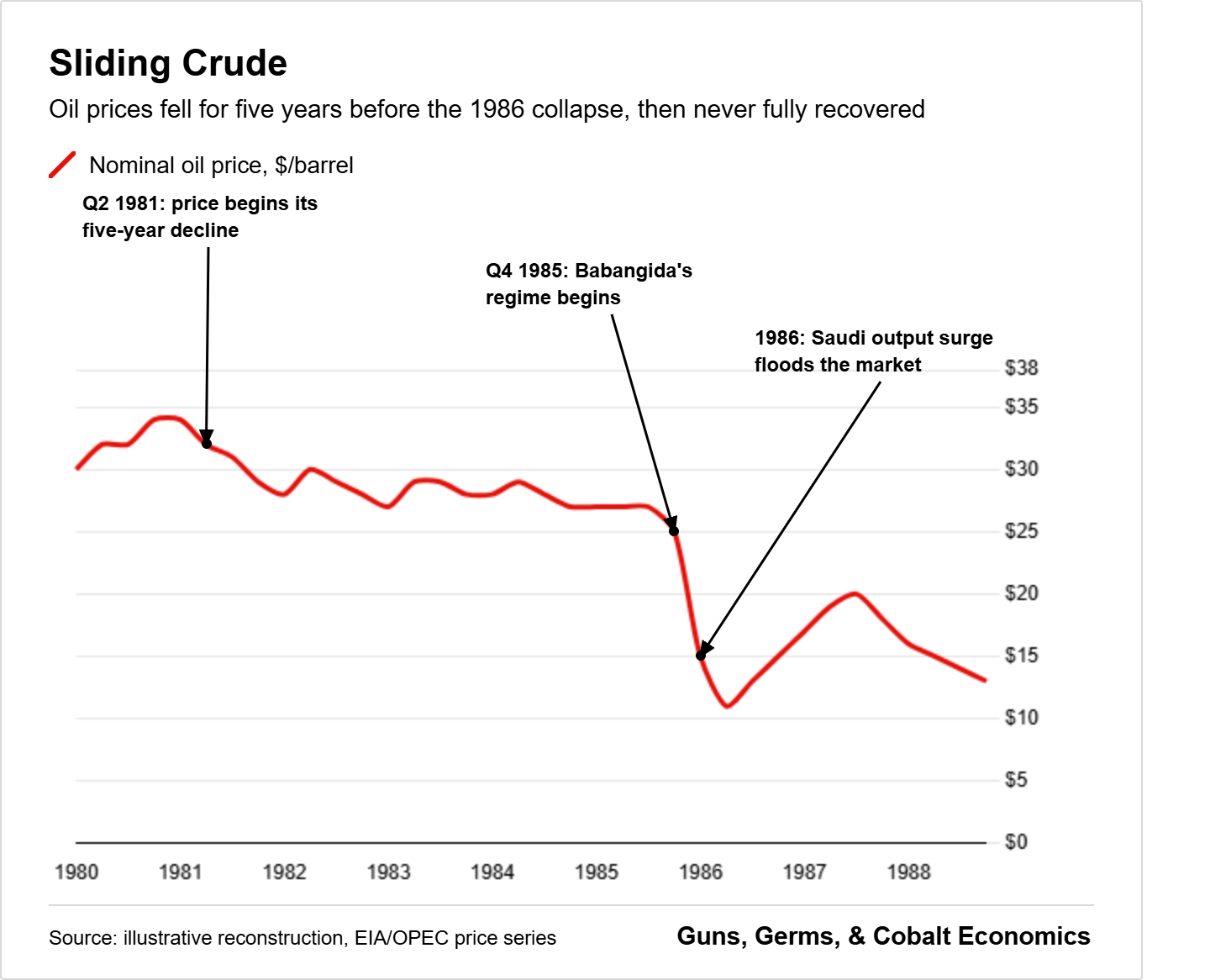
Desperate for FX to service its debt, Nigeria abandoned its OPEC quota of 1.3M barrels a day and sold every drop it could pump. But higher production couldn’t offset the collapsing price.
The revenue numbers capture the devastation. In 1980, Nigerian federal revenue exceeded $20B. By 1986, thanks to the Saudi-driven oil price war, Nigeria’s government revenue collapsed to $5B.
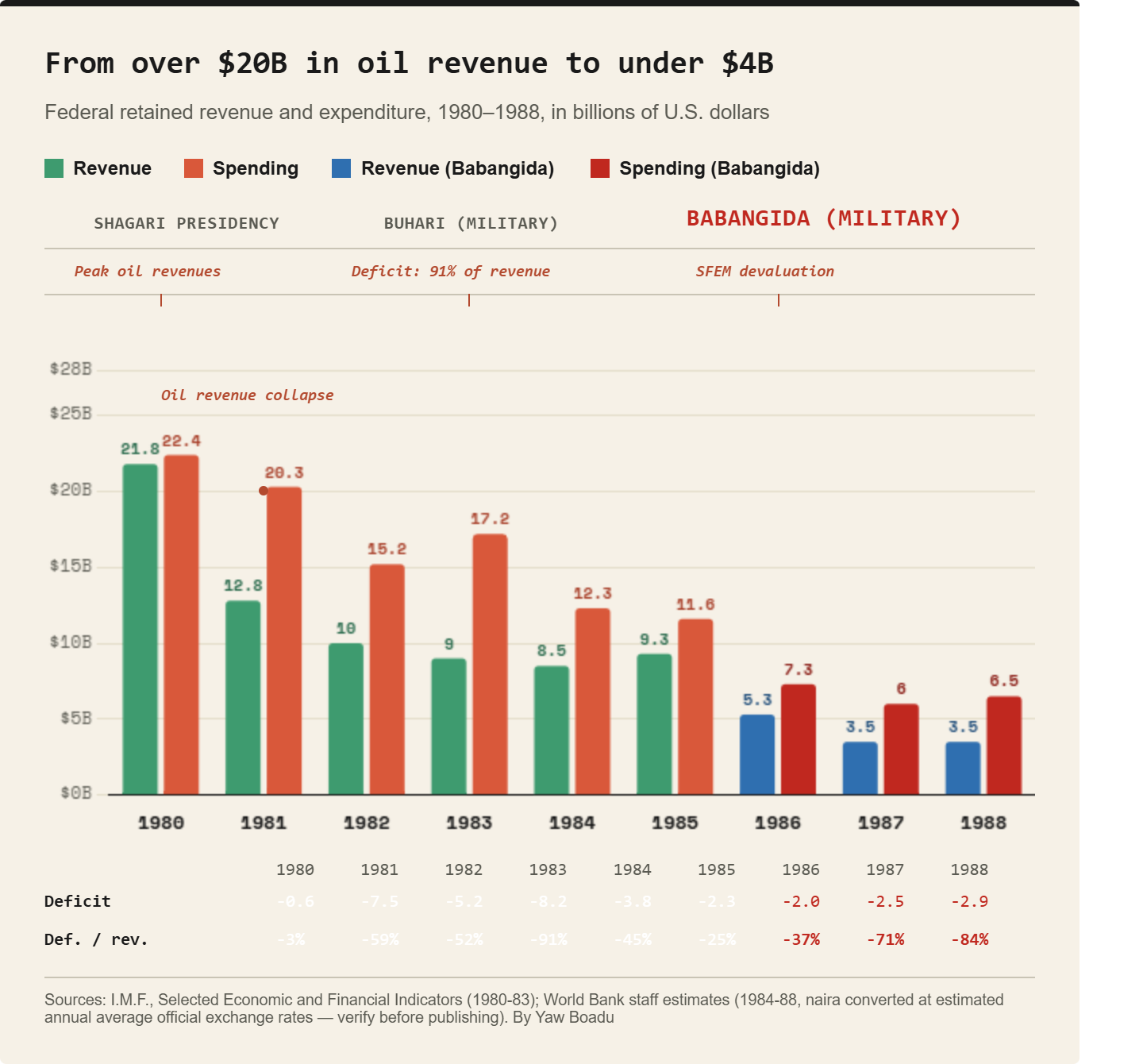
This fatal blow slashed Babangida’s planned $15.6B budget in half. The 2nd 1980s oil crash delivered a fatal double whammy: simultaneously destroying Nigeria’s government revenue in naira and the FX earnings needed to import goods & service foreign debt.
Babangida’s Political Massaging
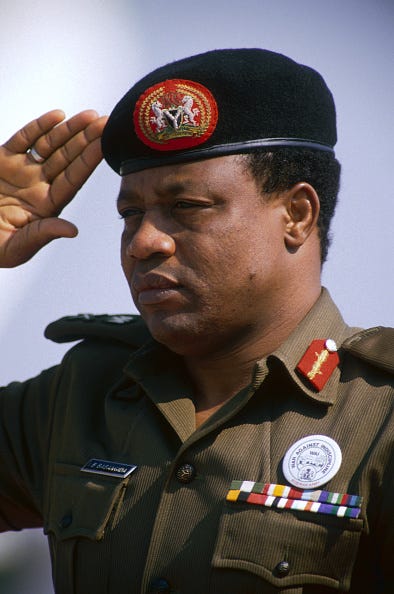
Babangida was about to impose painful reforms, so he started with a charm offensive. To contrast himself with Buhari’s iron fist, he repealed Decree No. 4, which criminalized journalism that embarrassed the government, freed jailed reporters and 100s of political prisoners, reined in the NSO (Nigeria’s secret police), and appointed several critics of Buhari to his cabinet.
Babangida also announced in 1986 that Nigeria would return to democracy again by 1990 (he eventually delayed it to 1992). He would bring back democracy in stages: first local elections, followed by a constituent assembly, a new constitution, two federally recognized political parties, state elections, a national census, federal elections, and finally a new president. He planned to maintain a US-style Federal constitution just like the failed 2nd Republic.
The first test came with local elections in December 1987, and it was mayhem. The National Electoral Commission badly mismanaged the vote. Ballot shortages prevented many Nigerians from voting, while stolen ballot boxes and attempted rigging triggered violence in Lagos. One candidate allegedly stabbed his rival in Ondo (Yoruba Southwest), while police arrested people in Bendel (Edo South Central) and Bauchi (Muslim North) with piles of voting cards and ballot boxes.
The IMF Choice
To survive, Nigeria needed a financial lifeline.
The IMF offered a $2.4B loan with conditionalities that would also unlock financing from the World Bank ($1.5B). Then after some debt restructuring, & rescheduling, commercial banks would be willing to lend another $1B.
The conditionalities were:
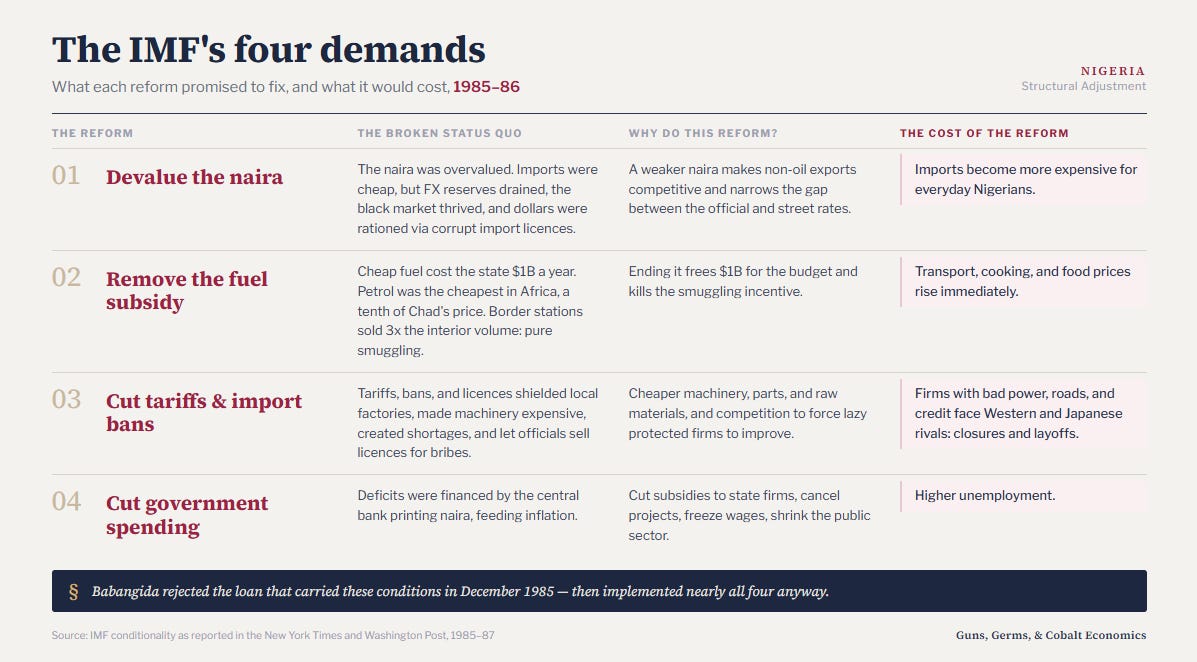
Babangida understood the political landmines. Most Nigerians viewed the IMF not as a neutral lender but as a “neocolonial” institution. In a strategy to build rapport with the Nigerian public, in October 1985, Babangida invited a public debate on whether Nigeria should take its first IMF loan or not.
Inviting Debate (October 1st - Dec 1985)
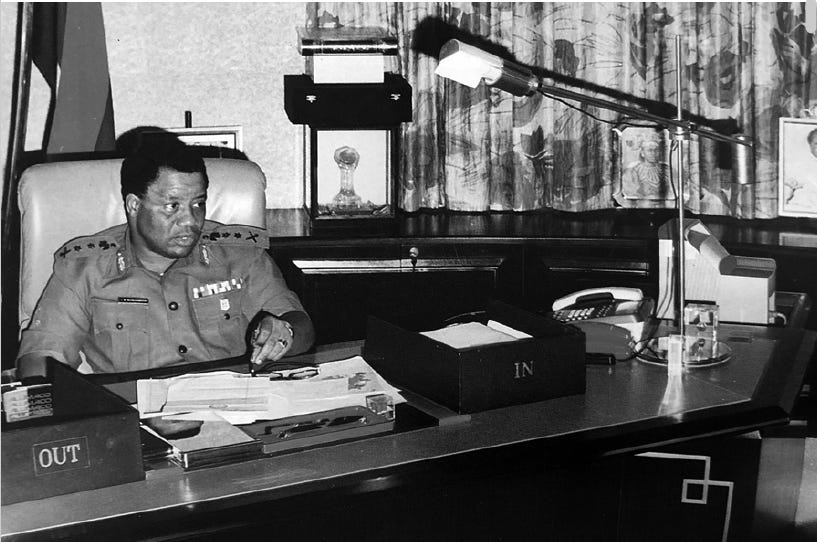
The IMF loan debate exploded in public life. For three months, Nigerians argued in street corners, taxis, markets, state TV, and in the pages of Nigeria’s 16 daily newspapers.
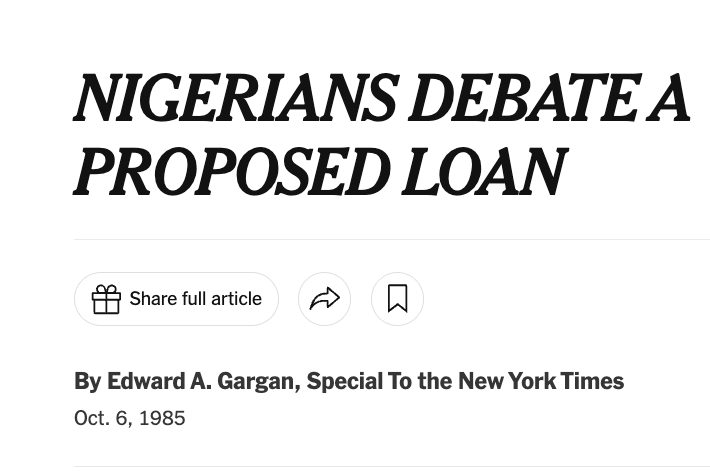
The answer from bishops, professors, business executives, labor unions, university students, traditional tribal rulers, elite Nigerians, and ordinary Nigerians was an overwhelming hell no.
Most Nigerians viewed the IMF loan as an attack on Nigeria’s sovereignty and assumed the military government would just steal the funds anyway.
As a result, Babangida read the room and rejected the IMF loan. But there’s a difference between an IMF loan vs. IMF reforms. Nigeria was still frozen out of international lending, and foreign creditors wanted the IMF to certify that Babangida’s IMF-esque reforms were credible.
As a result, Nigeria accepted a precautionary IMF standby arrangement while announcing it would never draw the money. Pay attention to the “Amount Agreed” vs. “Amount Drawn” below. The amount drawn is zero each time. During the Babangida era, Nigeria applied for three IMF credit cards, but never spent a cent with them.
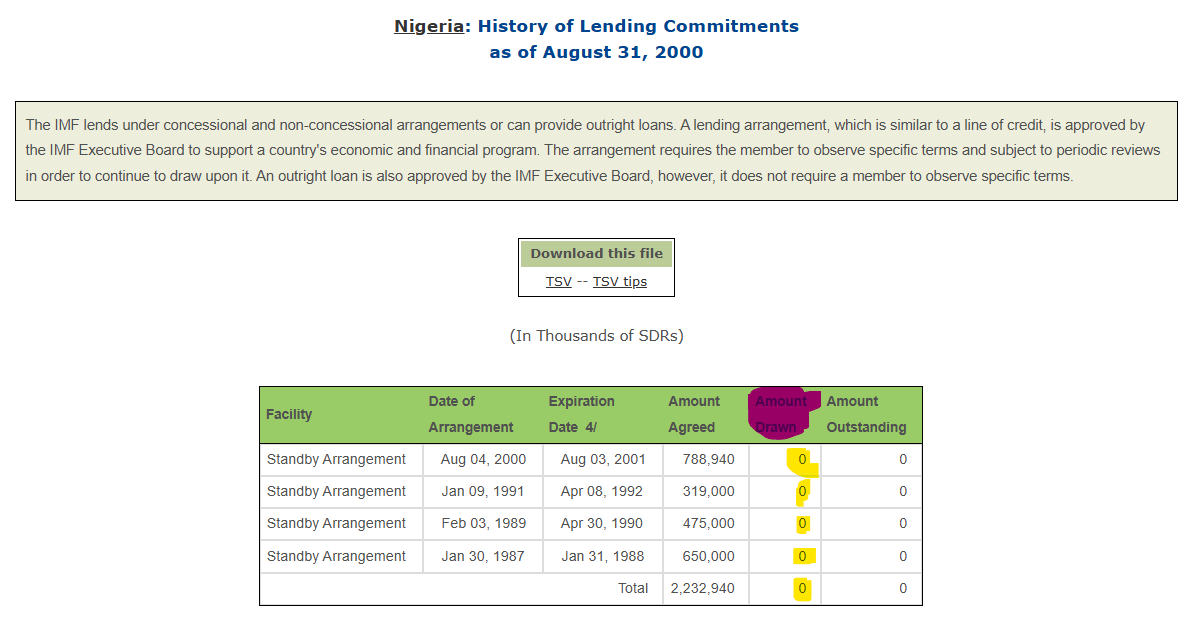
Because IMF loans are delivered in tranches tied to strict compliance, taking the money meant answering to Washington. By refusing the cash, Babangida escaped the IMF’s leash: the IMF still set targets and monitored his progress, but it couldn’t threaten to cut off money that Babangida never spent. Instead he ran his own structural adjustment program (SAP) that he said “our structural adjustment program was produced by Nigerians for Nigerians.”
Even though Nigeria didn’t take an IMF program, the IMF still approved Nigeria’s SAP, which was the greenlight Nigeria needed to reopen international lending.
In December 1986, the Paris Club, a group of mainly Western lending governments, agreed to reschedule $7.5B of Nigeria’s medium & long term debt over 10 years and give Nigeria a 5 year grace period. Also, the London Club, a group of Western commercial banks, agreed to restructure $2.8B in Nigeria’s unpaid letters of credit.
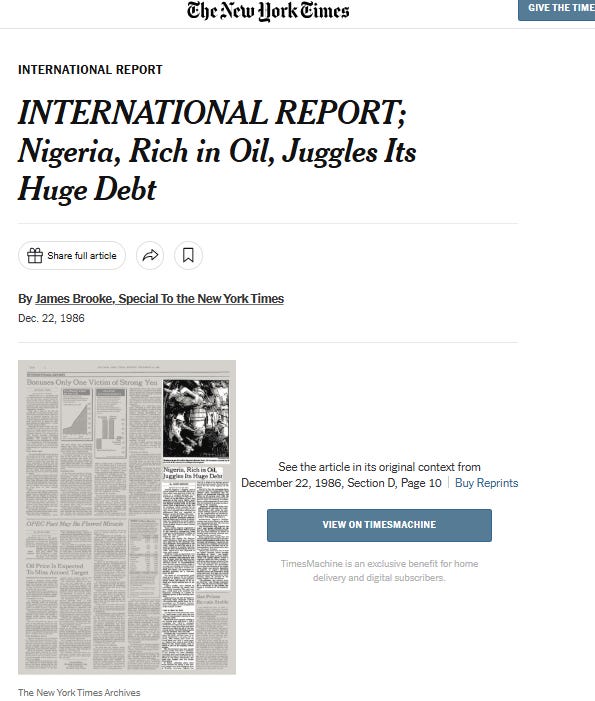
The funny part is that while he publicly rejected the IMF loan to appease the masses, he quietly swapped the IMF loan for a $500M, low interest rate World Bank (WB) loan. His “homegrown” SAP was really a way to unlock World Bank financing, which eventually expanded to a $4.2B lifeline by 1989.
A World Bank official described the maneuver “a political masterpiece. If he had done exactly the same thing under the aegis of the IMF, there would have been riots or a coup d’etat.” Imposing politically explosive reforms while successfully spinning it as an act of “Nigerian sovereignty” was one of the many reasons why Babangida was called an “evil genius”.
#SAP Phase 1: Spending Cuts
Babangida’s spending cuts included a 20% wage cut for high-earning public sector employees, including the military. Some military officials hated the salary slash and tried to overthrow him in December 1985, but the plot failed.
The oil price collapse and spending cuts also affected Universities. In 1986, students in Ahmadu Bello University in Zaria protested over shortages of lecturers and books, deteriorating campuses and few jobs awaiting graduates. In May 1986, the protests escalated and the police shot students, killing 15 people.
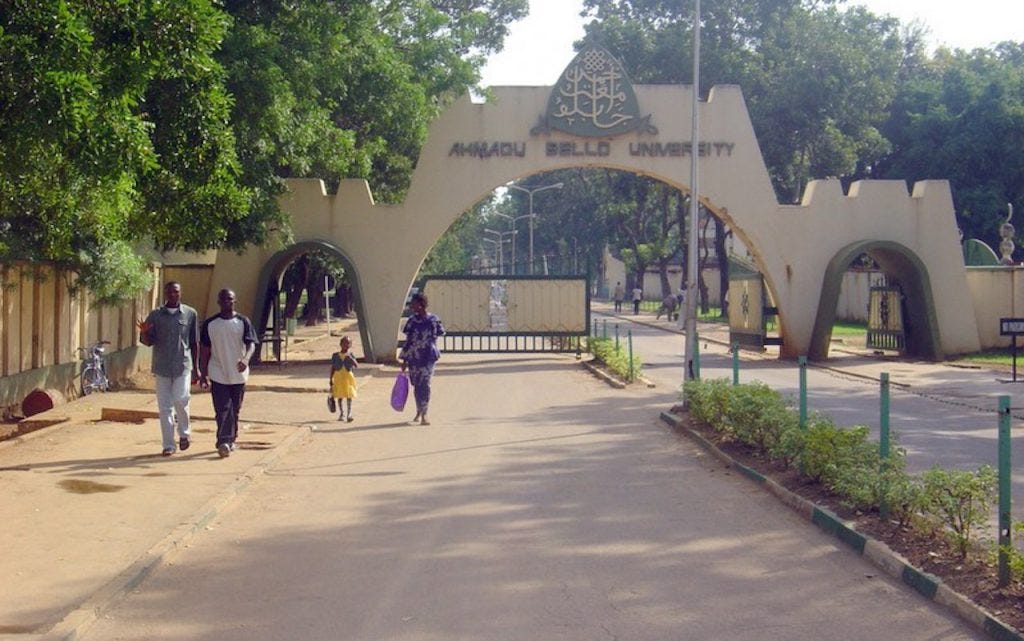
These deaths triggered more protests at other universities as well.
#SAP Phase 2: Devaluation: The Second Tier Foreign Exchange Market
The centerpiece of Babangida’s homegrown SAP was solving the currency crisis. The IMF wanted a straightforward devaluation. Instead, Babangida’s finance minister, Kalu I. Kalu created a two-tier market.
In order to explain this, I’ll explain the system before SFEM.
Before SFEM: The Import License Cartel
Imagine trying to buy tickets to a sold-out concert. The official box office sold tickets for $10, but only insiders had that cheap price. Everyone else must buy the tickets from alleyway scalpers for $40. Before 1986, this is how getting access to US dollars worked in Nigeria.
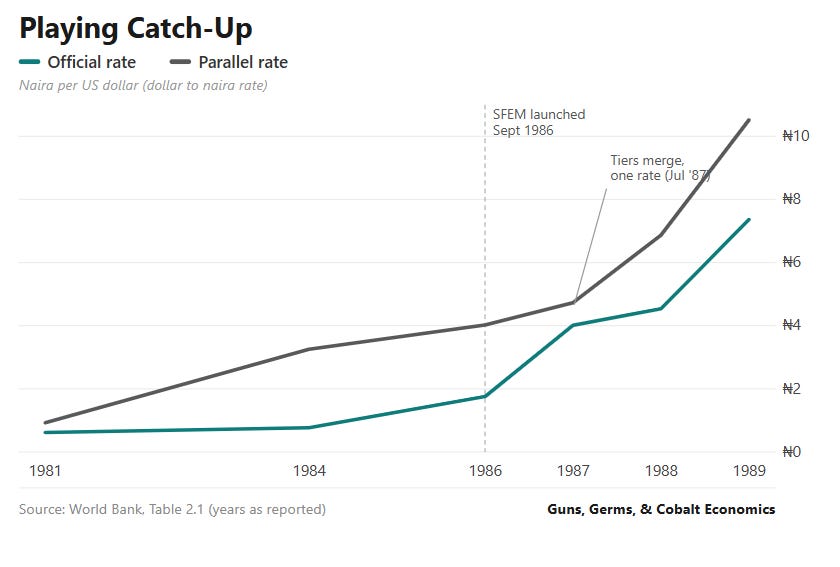
The Nigerian Central Bank artificially made the naira stronger than the dollar. (In 1984, $1 was ₦0.8 naira on the official rate, while the black market rate was $1 was ₦3.25). As the 1980s oil price crash dried up Nigeria’s FX dollar supply, the government rationed its remaining FX via “import licenses”.
That turned political access into free money. Anyone with a relative or friend inside the Ministry of Trade could secure an import license to buy $1M at the official rate (₦0.8 to $1), paying ₦800K. If he flipped the $1M at the black market rate (₦3.25 to $1), ₦800K becomes ₦3.25M, netting ₦2.45M profit just from insider access.
Also, depending on the license, the Nigerian bureaucrat could sell the license itself for $1M and have a few Mercedes, afford school for their kids in England, and go to holidays in London. The import license system minted millionaires out of hundreds of Nigerians.
Meanwhile, factories without political connections could not get the import license to acquire the FX needed for machines, spare parts, or raw materials. Nigeria had demand for manufactured goods, but its FX system starved firms of the inputs needed to make them.
SFEM Solution
Babangida’s Second Tier Exchange market blew up the import license cartel without the IMF’s suggestion of floating the currency.
While the SFEM technically split the official FX market into two-tiers, it created a chaotic system of three competing exchange rates in Nigeria:
1st Tier (The VIP Line): The artificially cheap rate, reserved for the government ($1= ₦1.3) to pay off foreign debt and funding embassies abroad.
2nd Tier (The Public Auction - SFEM): Banks bid for a limited pool of FX via weekly Central Bank auctions. This was a subtle devaluation; the first auction was 1 dollar = 4.6 naira.
The Black Market Rate: The true, unregulated & weakest naira to dollar rate
Also, to formalize some black market activity into the formal banking system, Kalu legalized foreign exchange “domiciliary accounts”, allowing Nigerians to legally hold dollars in domestic banks and convert them to naira at the SFEM rate.
After SFEM launched, the official rate and black rate started to converge.
The New Hustle: “Round—Tripping”
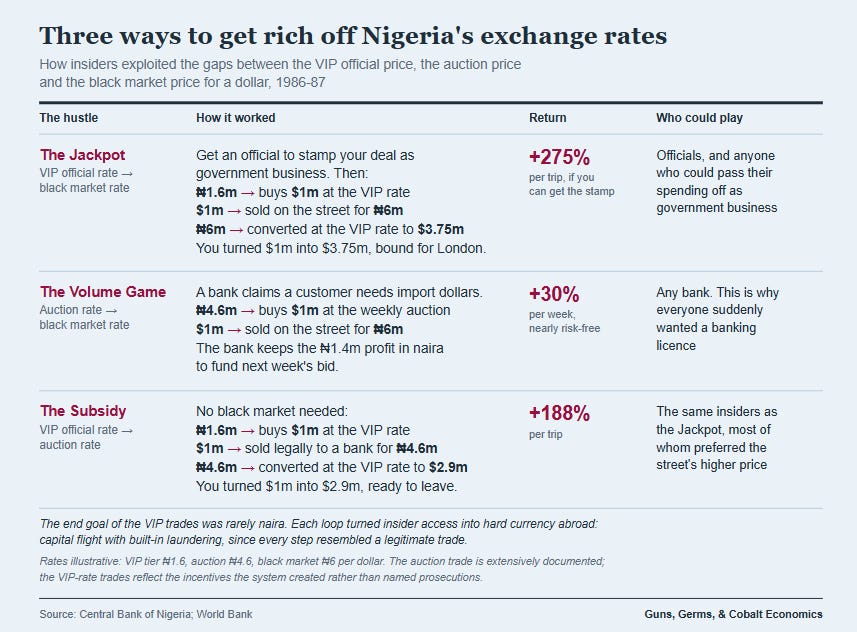
Sadly, SFEM didn’t end rent-seeking. Instead, it directed the old import-license arbitrage to a new hustle called “round-tripping”.
Any gap between the three rates created an arbitrage opportunity (free money). Banks obtained dollars at Central Bank auction, supposedly for importing businesses, and then sold some of those dollars to the black market for naira profit. The graphic below shows the different round-tripping permutations:
The arbitrage was out of control. So, in 1987, Babangida tried collapsing Tier 1 and 2 into a single unified, auction-based foreign exchange rate.
While unifying rates briefly reduced the spread between the official auction rate and the black market rate to as low as 3.6%, this strategy didn’t fix Nigeria’s fundamental issue: demand for FX outstripped Nigeria’s FX supply & earnings.
By 1988, the government spent well beyond its budget (more salaries, contracts, subsidies to state-owned firms). The extra naira was converted to dollars to pay for imported food and manufactured goods, so demand for dollars surged in Nigeria. In 1988, Nigeria had a month of FX remaining. The strong dollar demand made the black market naira rate depreciate and the CBN refused to let the official rate converge with it. By 1989, the nominal effective exchange rate was worth roughly a tenth of its 1985 value. Overall, the whole scheme was really just a long-winded, slow method to devalue the currency, in order to decrease the number and scale of the riots.
Result of devaluation
While cash crop farmers earned more naira for exports, urban consumers and import-dependent factories suffered as the naira cost of imported goods skyrocketed.
Factories responded by raising prices, cutting production, laying off workers or closing.
For consumers, the prices for foreign cars tripled and the purchasing power of middle class savings in Lagos and wages collapsed when expressed in dollar terms.
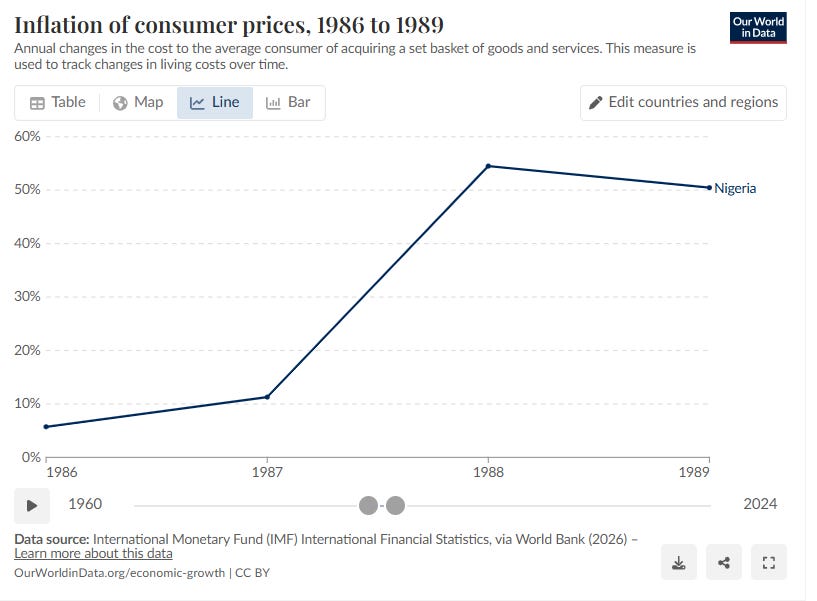
When we look at inflation, in 1986, Nigerian inflation was 5.72%, by 1989, inflation was over 50%.
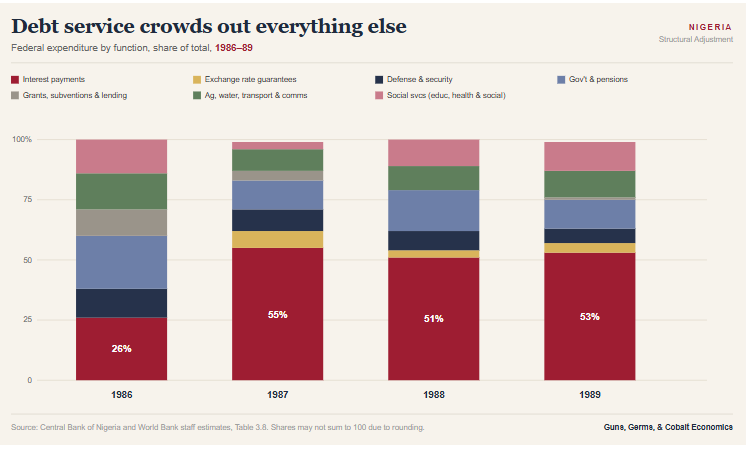
Also due to the devaluation, Nigeria’s dollar denominated payments exploded. Instead of debt taking up 25% of budget, it exceeded 50%. Other aspects of government spending were sacrificed.
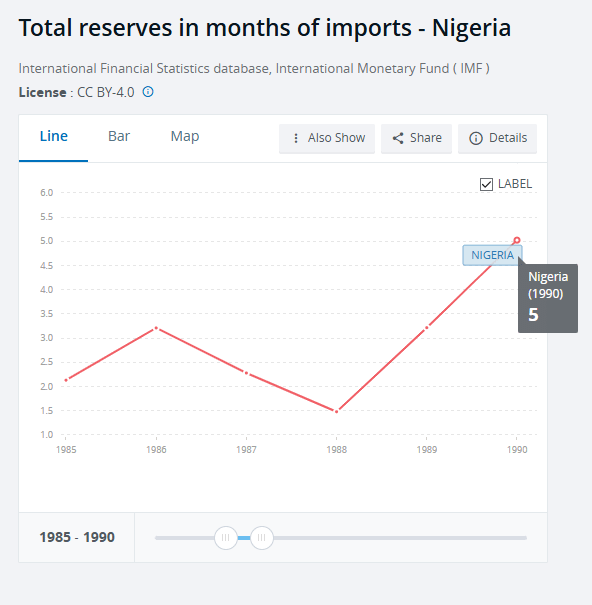
The positive side was that devaluation allowed less dollars to be spent propping up the naira. By 1989, Nigeria had over 3 months of FX reserves again and by 1990, Nigeria had 5 months.
#SAP Phase 3: Fuel Subsidy Cuts
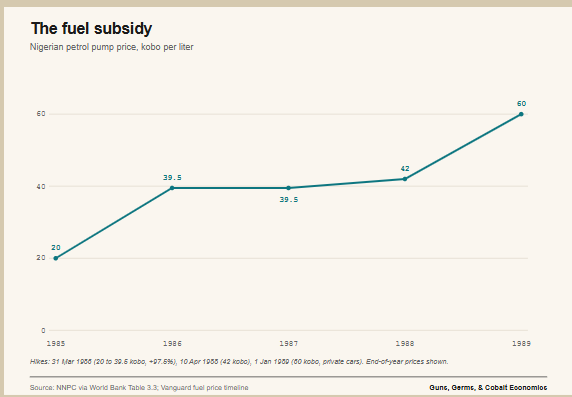
Fuel subsidy cuts added to inflation too: fuel prices doubled in 1986, rose 6% in 1988, then 43% in 1989, each cut triggering deadly riots & protests. See petrol prices below:
#SAP Phase 4: Trade Liberalization
Babangida ended the 30% import surcharge, cut banned import items from 74 to 16, and reduced tariffs (from 200% to 40% in Jan 1988).
For factories that could obtain FX more easily now, lower tariffs reduced the cost of importing machinery and industrial components. But, the reforms also exposed local producers to foreign competition before Nigeria solved its electricity, transport, financing, and productivity problems.
Nigerian manufacturing was already struggling since the 1980s, but trade liberalization continued the decline. On paper, Nigeria’s manufacturing value-add plunged from $33B in 1981 to $8.1B by 1989.
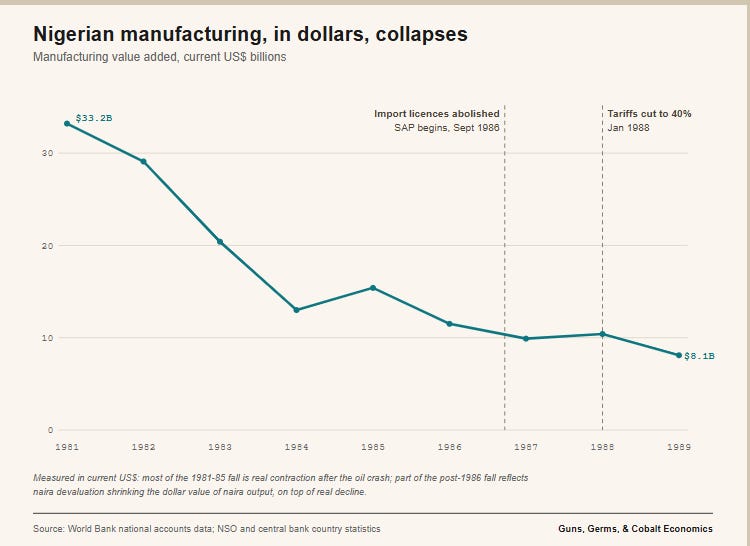
But this drop is mainly currency devaluation, so measuring factory output in USD is a tad misleading.
If you measure in constant naira or by capacity utilization instead, the picture changes: mild recovery during the SAP period, though well below the 1981 peak.
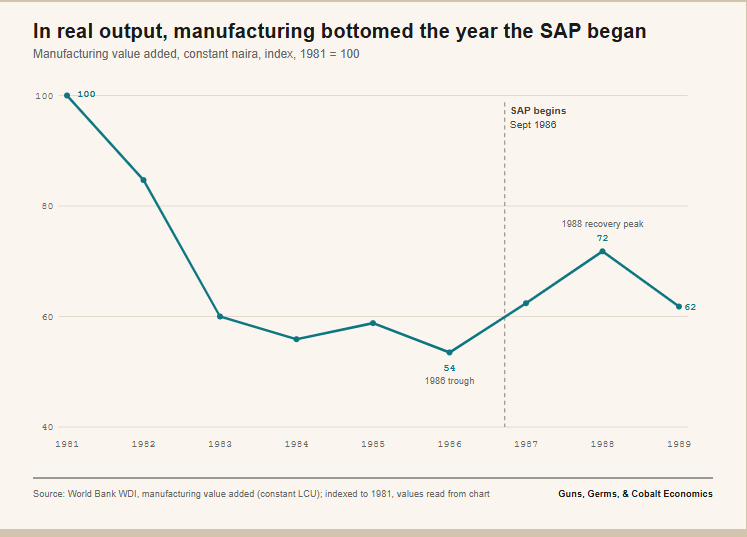
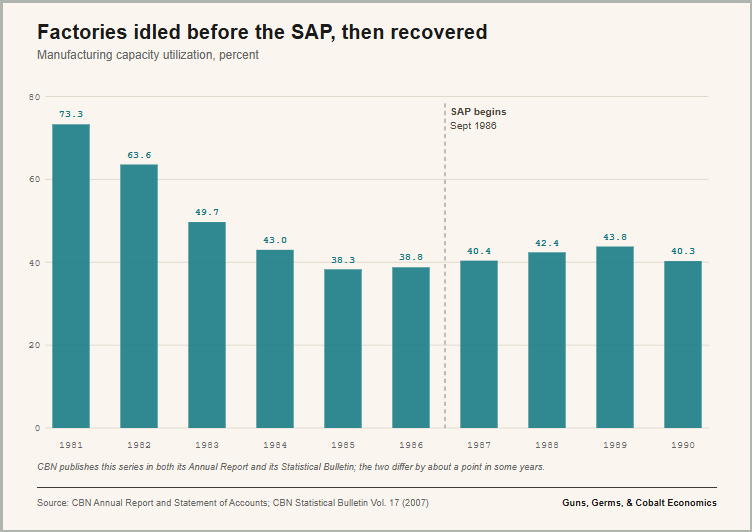
While trade liberalization and a weaker naira did impact Nigeria’s import-dependent urban factories, the same devaluation, combined with removing state price controls, sparked a boom in the rural farming sector.
#SAP Phase 5: Agriculture Liberalization
In 1986, Babangida repealed the Commodity Board Decree of 1977 and the Price Control Decree of 1970, which dismantled the six national commodity marketing boards (Cocoa, Groundnut, Rubber, Palm Produce, Cotton, Grains).
How Agriculture worked Prior to Liberalization
These government-controlled boards were created during colonialism and post-independence governments appropriated and expanded them. The boards were state-run monopsonies: they acted as the sole legal buyers of agricultural exports, forcing farmers to accept state-mandated farm-gate prices that sat well below the world-market values so the government would capture the bulk of export revenue.
The government farm-gate prices were so low that it killed the farmers’ incentive to expand. A farmer might continue producing with existing land and family labor, but increasing output required more workers, equipment, transport, and risk. If the farm-gate price was lower than these additional costs, then expansion made no economic sense. Here’s some numbers:
Global cocoa price: $2200 per ton
Marketing board’s farm-gate price: $400 per ton
Marginal cost with family labor: $300 per ton (profit $100 per ton)
Marginal cost after hiring workers, buying pesticides, and planting trees ($450 per ton), the farmer won’t do it, the government price is too small (profit: -$50 per ton)
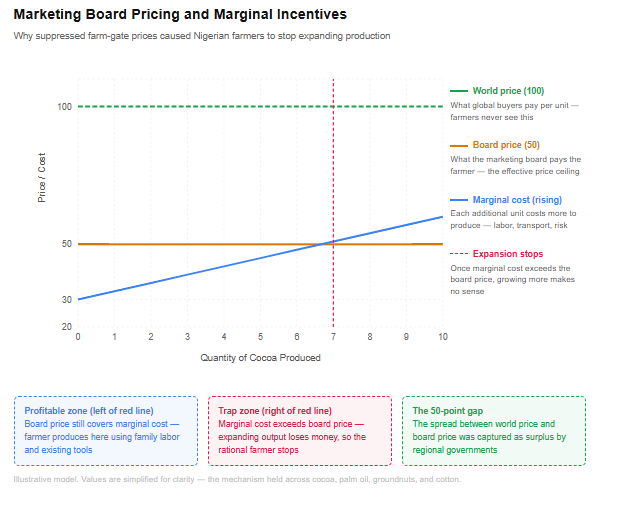
Even when boards raised farm-gate prices, the price wasn’t high enough to make expansion rational for farmers.
Economic Liberalization
After Babangida abolished the boards, farmers could sell directly to private traders, processors, and exporters at market-driven prices. Cocoa farmers, for example, saw their net margins go from losing ₦105 per hectare in 1985, pre-liberalization, to a profit of ₦1,586 per hectare in 1989 post-liberalization. For large corn farmers gross margin per hectare rose from ₦608 to ₦1311.
Production of several export crops exploded, especially rice & cotton, see chart below:
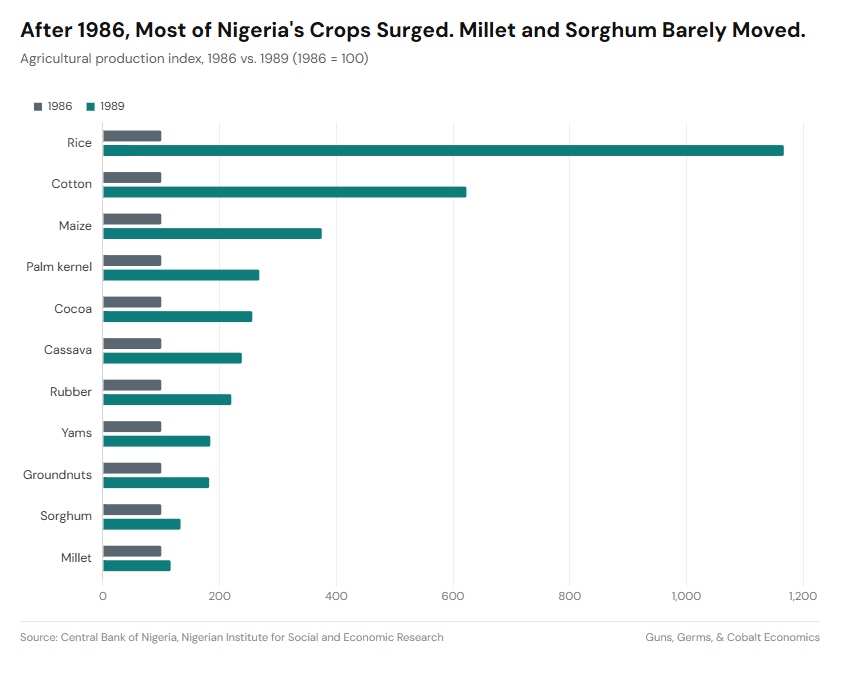
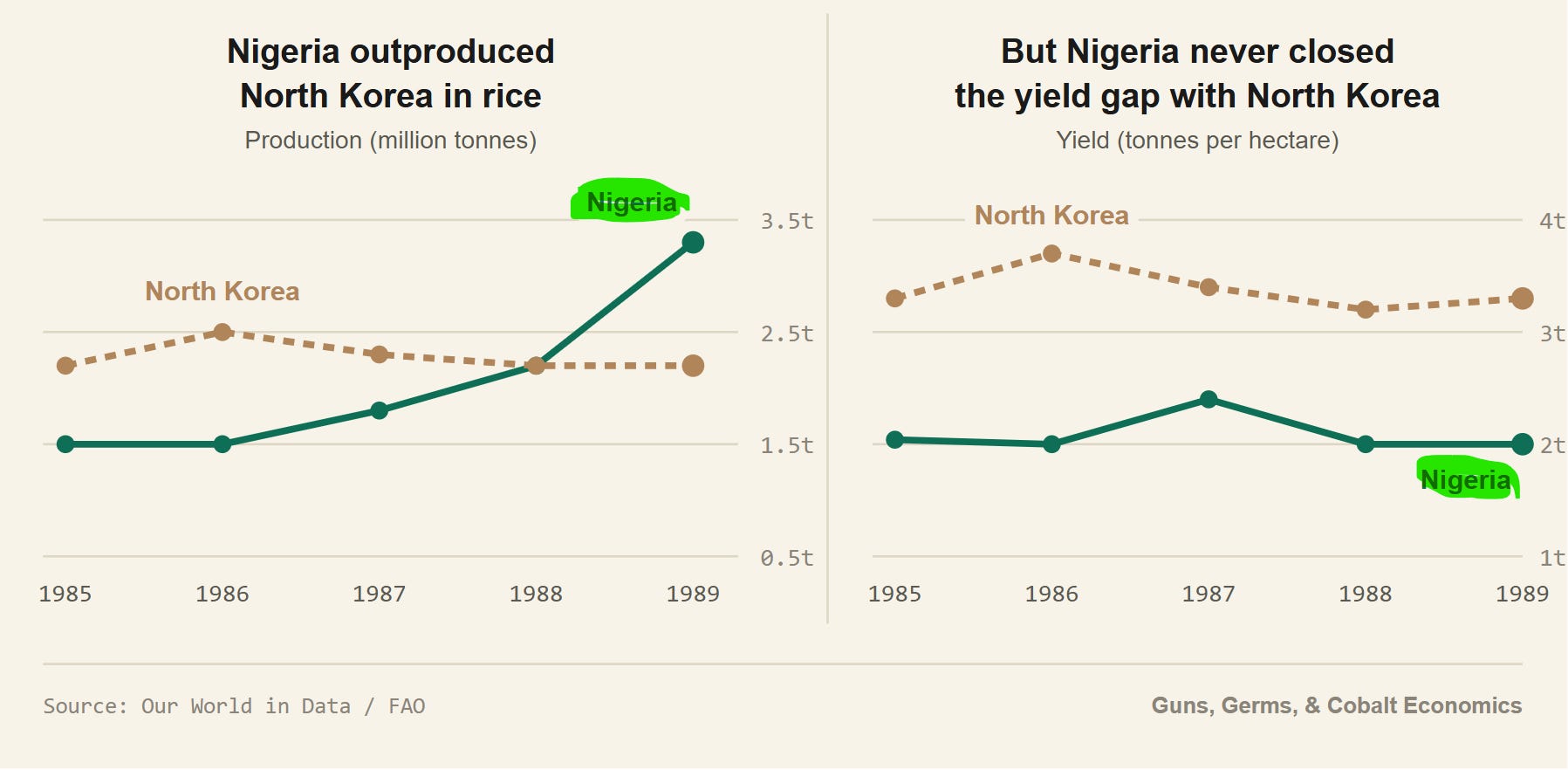
If we take a magnifying glass, Nigeria’s rice growth is interesting. Nigeria’s rice production growth came because farmers cultivated more land, not because they were more efficient with their existing plots. By 1989, Nigeria produced more rice than North Korea, but Nigerian yields are only ~60% of North Korea’s.
Lastly, Babangida increased spending on construction on farm-to-market roads, which was severely lacking in Nigeria and most of Black Africa. This was just low-hanging fruit.
Considering that agriculture employed two-thirds of the Nigerian work force, this period was good for the average rural Nigerian laborer.
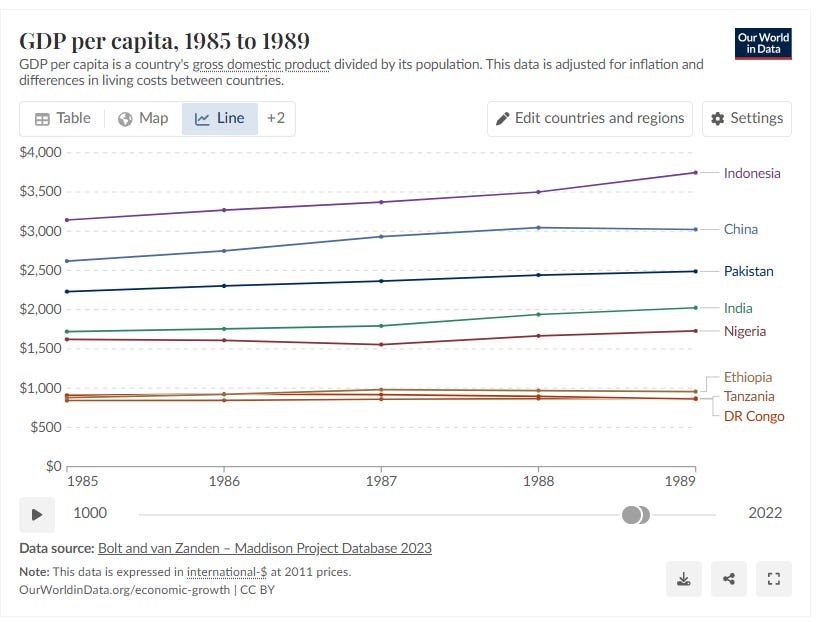
At this time, Indonesia, China, Pakistan, and India pulled further away from Nigeria. But Nigerians were still much richer than Ethiopians, Congolese or Tanzanians.
Concluding Thoughts
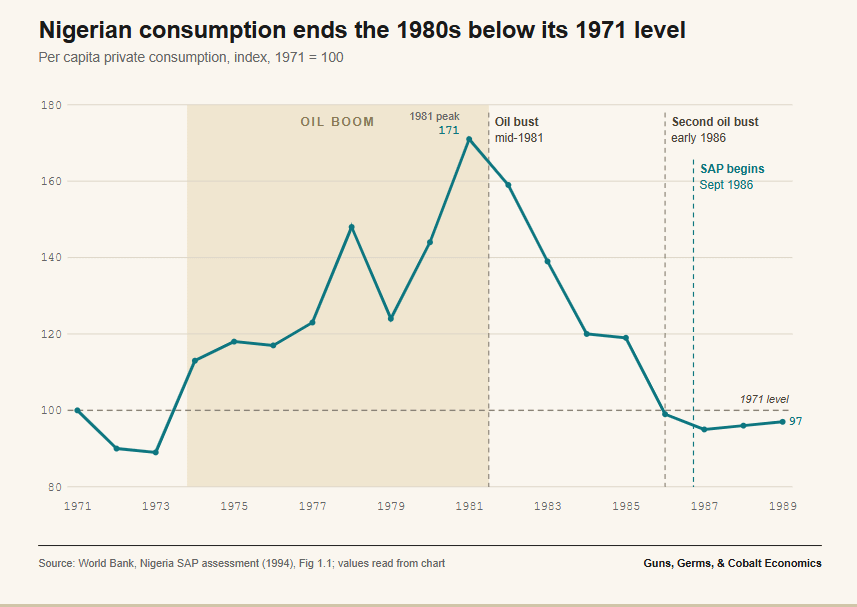
While popular memory in Nigeria blames the SAP for ruining the country, Nigeria’s rot long preceded the SAP. Nigeria’s collapse was triggered by the mid-1981 oil crash, and sealed by the 1985 Saudi price war, which destroyed Nigeria’s oil revenues. By the time the SAP launched in 1986, per capita consumption had already plummeted 40% from its 1981 peak.
Overall the reforms were mixed. The SAP dismantled corrupt import license cartels, reduced cross-border fuel smuggling, and sparked a rural agricultural boom by abolishing the marketing boards. At the same time, currency devaluation, budget cuts, and fuel subsidy cuts devastated middle-class urban centers and university students. Tariff liberalization exposed domestic factories to global competition it wasn’t ready for yet.
Ultimately, the negatives are remembered more than the positives, creating a generational public distrust of “neoliberalism”. Next time: Privatization, religious tensions, and Babangida’s famous broken promise in returning Nigeria to democracy.
Fascinating read. My overall macroeconomic takeaway is that Nigeria would’ve been better off letting the Nairu float freely, or perhaps even be tied to some kind of US Dollar peg, given that earnings were nearly all from petroleum, which is priced in dollars. The same with agricultural prices. Let the market price goods.
My recollection of that era is that many newly independent African countries were smitten with the idea of socialism and top down policies. It has held back development there, as it does everywhere it’s tried. I look forward to the next installment
Woahhhh. This is a really charitable reading of Babangida. Where is the corruption? The murders? The looting?
I hope you cover that in your next article.